SEA総合研究会関連資料 第2回検討会(平成10年10月5日)
Executive Summary
Draft Programmatic Environmental Impact Statement/Environmental Impact Report
March 1998
INTRODUCTION
THE CALFED PROGRAM
PRIMARY OBJECTIVES OF THE CALFED PROGRAM
SOLUTION PRINCIPLES
FUNDAMENTAL PROGRAM CONCEPTS
PROGRAM STUDY AREA
PROGRAM ALTERNATIVES
INTEGRATION OF PROGRAM ELEMENTS
SUMMARY OF ENVIRONMENTAL CONSEQUENCES
MOVING TOWARDS THE PREFERRED PROGRAM ALTERNATIVE
INTRODUCTION
| CALFED intends to protect the Quality of the Bay-Delta, which serves some of America's most populous cities, most productive farms and most precious environmental treasures. |
The Bay-Delta is the largest estuary on the West Coast. It consists of a maze of tributaries, sloughs and islands and is a haven for plants and wildlife, supporting more than 750 plant and animal species. The Bay-Delta is critical to California's economy, supplying drinking water for two-thirds of all Californians and irrigation water for 250 crops and livestock commodities which make California the world's largest agricultural economy. Although all agree on its importance for both habitat and as a reliable source of water, few have agreed on how to manage and protect this valuable resource. For decades the Bay-Delta has been the focus of competing economic, ecological, urban and agricultural interests. These conflicting demands have resulted in declining wildlife habitat, native plant and animal species becoming threatened with extinction; the degradation of the Delta as a reliable source of high quality water; and a Delta levee system faced with a high risk of failure. Even though environmental, urban and agricultural interests have recognized the Delta as critical, for decades they have been unable to agree on appropriate management of the Delta resources. Seeking solutions to the resource problems in the Bay-Delta, state and federal agencies signed a "Framework Agreement" in June of 1994 which provided increased coordination and communication for environmental protection and water supply dependability. The impetus to forge this joint effort came at the State level in December 1992 with formation of the Water Policy Council. The following year, in September 1993, the Federal Ecosystem Directorate was created at the Federal level to coordinate federal resource protection and management decisions for the Bay-Delta system. The Framework Agreement laid the foundation for the Bay-Delta Accord and CALFED. |
|
The Framework Agreement pledged that state and federal agencies would work together in three areas of Bay-Delta management:
The CALFED Bay-Delta Program (CALFED Program) is charged with responsibility for the third issue identified in the Framework Agreement. This Programmatic Environmental Impact Statement/ Environmental Impact Report (Programmatic EIS/EIR) evaluates this long term program. THE CALFED PROGRAMThe CALFED Program is a cooperative, interagency effort involving 15 state and federal agencies with management and regulatory responsibilities in the Bay-Delta Estuary. Bay-Delta stakeholders also contribute to the Program design and to the problem-solving/ decision-making process. Public participation and input have been essential throughout the process and have come through the Bay-Delta Advisory Council (BDAC), public participation in workshops, scoping meetings, comment letters, and other public outreach efforts. BDAC is chartered under the Federal Advisory Committee Act and is comprised of stakeholders, including water districts and utilities, environmental organizations, the California Farm Bureau, and sport fishing organizations from throughout California appointed by the administration of Governor Wilson and President Clinton, through Secretary of the Interior Babbitt. This group of public advisors helps define problems in the Bay-Delta, helps to assure broad public participation, comments on environmental analysis and reports, and offers advice on proposed solutions.
|
|
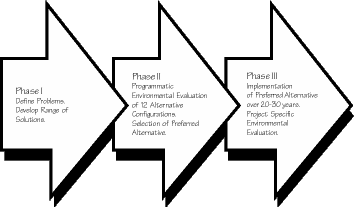
| The CALFED Bay-Delta Program is using a three-phase process to identify problems, propose solutions, analyze environmental impacts and develop a long term solution.
The Mission Statement does not stand alone as a single statement of CALFED Program purpose. Rather, the Mission Statement is supported by sets of Primary Objectives and Solutions Principles. |
In Phase II, the Program refined the preliminary alternatives, conducted a comprehensive programmatic environmental review, and is developing implementation strategies. In Phase II, the Program has added greater detail to each of the Program elements and crafted frameworks for two new CALFED Program elements: water transfers and watershed management. Phase II will conclude with the selection of a preferred program alternative, development of an implementation strategy including financing and assurances, and completion of a Final Programmatic Environmental Impact Statement/ Environmental Impact Report . In Phase III, following completion of the final Programmatic EIS/EIR, implementation begins. This period will include additional site-specific environmental review and permitting. Because of the size and complexity of any of the alternatives, implementation is likely to take place over a period of decades.
The Mission Statement is important and reflects the basic intent of the CALFED Program. However, the full expression of the CALFED Program mission is reflected in the Mission Statement, Objectives, and Solution Principles read together. |
PRIMARY OBJECTIVES OF THE CALFED PROGRAM:
|
Ecosystem Quality Improve and increase aquatic and terrestrial habitats and improve ecological functions in the Bay-Delta to support sustainable populations of diverse and valuable plant and animal species. Water Supply Reduce the mismatch between Bay-Delta water supplies and the current and projected beneficial uses dependent on the Bay-Delta system. Water Quality Provide good water quality for all beneficial uses. Vulnerability of Delta Functions Reduce the risk to land use and associated economic activities, water supply, infrastructure, and the ecosystem from catastrophic breaching of Delta levees. |
| It is the capability of an alternative to optimize satisfaction of both the CALFED Program objectives and solution principles, which will determine the selection of the preferred program alternative. |
SOLUTION PRINCIPLES:The solution principles were developed as a means to achieve the CALFED Program's objectives in the context of a multi-purpose mission and a history of competing environmental, political, and institutional influences. The solution principles provide an overall measure of the acceptability of alternatives and guide the design of the institutional part of each alternative. Reduce Conflicts in the System. Solutions will reduce major conflicts among beneficial uses of water. Be Equitable. Be Affordable. Be Durable. Be Implementable. Have No Significant Redirected Impacts. |
FUNDAMENTAL PROGRAM CONCEPTS
|
The importance of a unit of water in the system is not fixed, but varies according to the flow rate, the time of year, and the water year type. The preferred alternative will need to include an implementation strategy to assure that the Program will be financed, constructed and operated as agreed. |
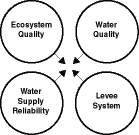
Four fundamental concepts related to the Bay-Delta system and its problems have guided the development of proposed CALFED solutions. These concepts are not new, but the Program has looked at them in new ways in order to develop options for solving problems successfully. Interrelationships Problems in the four resources areas of ecosystem restoration, water quality, water supply reliability, and levee system integrity are closely interrelated. Important physical, ecological and socioeconomic linkages exist between the problems and possible solutions in each of these categories. Problems in each resource area must be discussed within the context of other resource areas. It follows that solutions will be interrelated as well. Many past attempts to improve a single resource area have achieved limited success because solutions were too narrowly focused. System Variability and the Time Value of Water There is great variation in the flow of water through the system and in the demand for that water, at any time scale we might examine: from year to year, between seasons, even on a daily basis within a single season. The value of water for all uses tends to vary according to its scarcity and timing. This variability can be used to reduce conflict and solve problems in several resource areas. Adaptive Management The solutions implemented by the Program must be guided by adaptive management. Adaptive management is an interactive approach to decision making that incorporates feedback loops to evaluate actions and incorporate new information as it becomes available. No long-term plan for management of a system as complex as the Bay-Delta can predict exactly how the system will respond to Program efforts, or foresee events such as earthquakes, climate change, or the introduction of new species to the system. Actions that are taken to restore ecological health and improve water management will have to be adaptive. These adaptations will be necessary as conditions change and more is learned about the system and how it responds to the Program's efforts. The Program's objectives will remain fixed over time, but actions may be adjusted to assure that the solution is durable. Implementation Strategy Due to the complexity of the Bay-Delta system, the scope of the Bay-Delta solution, and the cost associated with implementing the solution, the preferred program alternative will be implemented in stages over a number of years. Certain elements of the Bay-Delta solution, such as potential storage and conveyance facilities, require more time to be designed, environmentally reviewed, and constructed while other program components, such as certain ecosystem restoration or water use efficiency actions, can be implemented sooner. Phased implementation also allows project costs for program components to be spread over time so as to distribute the financial burden. Phased implementation also stimulates concern that program components may not be implemented in the future as outlined in the preferred program alternative. There is general concern that program components slated for later implementation may suffer from inadequate funding in the future, or key stakeholder groups engaged in the collaborative process may withdraw their support in the future. The Bay Delta Advisory Council Assurances Workgroup was convened to formulate, discuss, analyze, and recommend to the BDAC appropriate mechanisms to assure implementation of the long-term Bay-Delta solution identified by the CALFED process. The preliminary assurance packages include assurance tools and mechanisms that received support from agencies and stakeholders. For assurance tools and mechanisms that did not attract consensus the packages present a range of options with accompanying rationale so that decision makers could select the appropriate assurance mechanisms in the future. |
PROGRAM STUDY AREA
|
No other single area is quite as crucial to the state's overall water picture as the Delta. |
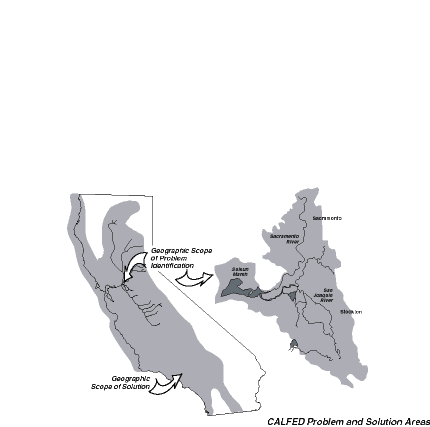
The CALFED Program is addressing problems which occur in or are closely linked to the Suisun Bay/Suisun Marsh and Delta area (Problem Scope). Any problem currently associated with the management and control of water, or the beneficial use of water within the Bay-Delta (including both environmental and economic uses) is within the scope of the Program if at least part of the problem occurs within the Bay-Delta or is directly associated with conditions in the Bay-Delta. In contrast to the Problem Scope, the Solution Scope is quite broad, potentially including any action which could help solve problems identified in the Bay-Delta. Since there is a wide range of actions encompassed within the basic project purposes and solutions, it follows that various actions will affect different geographic areas depending upon the nature and location of the action. Thus, although each action will not affect the entire geographical solution area, certain actions will directly or indirectly affect areas within the Central Valley watershed, Southern California water system service area, Suisun Bay, San Pablo Bay, San Francisco Bay, portions of the Pacific Ocean out to the Farallon Islands, and a near-coastal band extending from about Morro Bay to the Oregon border. |
PROGRAM ALTERNATIVES
|
The problems facing the Bay-Delta system are complex and interconnected. Solving them requires an integrated solution. The components of the Phase II alternatives are complementary, so that the whole is greater than the sum of the parts. |
The alternatives are programmatic in nature. They are intended to help agencies and the public make decisions on the broad methods which should be used to meet Program objectives. The alternatives are not intended to define site specific actions that will ultimately need to be designed and implemented. For example, the alternatives are not intended to define the precise size and location for surface water storage. They are intended to provide the decision makers enough information on whether or not storage in a size range is warranted, for example, in the Sacramento River watershed. The alternatives are comprised of building blocks referred to as Program elements. The basic structure from Phase I contained common and variable Program elements which were used to build the Phase II alternatives and their configurations. Common Program elements included levee system integrity, water quality, ecosystem restoration, and water use efficiency and variable elements included storage and conveyance. During Phase II two additional common Program elements, water transfers and watershed management were added to each alternative because of their value in helping the CALFED Program meet its objectives. The common Program elements resulted from a realization during Phase I that some categories of actions were so basic in addressing Bay-Delta system problems that they should not be optional nor be made to arbitrarily vary in level of implementation. The alternative configurations are shown in summary form and depicted in the figures on pages 11-14. The figures focus on the storage and conveyance element for each alternative. The other elements are listed in the text box within each figure. The six common Program elements provide the foundation for overall improvement in the Bay-Delta system. Implementation of these Program elements will result in a significant investment in and improvement of the resource conflicts in the system. The Program elements include: Ecosystem Restoration Represents the largest, most complex environmental restoration program ever undertaken in the State of California. Water Quality Will dramatically lower toxicants in the system. Water Use Efficiency Is expected to avoid over 3 million acre feet of water demand annually by year 2020. Levee System Integrity Will result in significantly improved system integrity by strengthening levees throughout the Delta. Water Transfers Will result in a more effective and protective water transfer market that will provide critical ecosystem flows without regulatory action and will result in a reduction of drought-induced economic damage. Coordinated Watershed Management Is a comprehensive long-term program to encourage habitat enhancement, reduce pollutant loads, and help stabilize runoff. INTEGRATION OF PROGRAM ELEMENTSThe performance of each common element is enhanced when developed together as part of the overall CALFED Program. Additionally, the total performance is enhanced (or the risks reduced) by the range of modifications under consideration in the variable (storage and conveyance) Program elements. In addition to the common Program elements, some of the alternatives include provisions for new or expanded water storage, and each alternative includes modification of Delta conveyance. Storage of water in surface reservoirs or groundwater basins can provide opportunities to improve the timing and availability of water for all uses. The benefits and impacts of surface and groundwater storage vary depending on the location, size, operational policies, and linkage to other Program elements. |
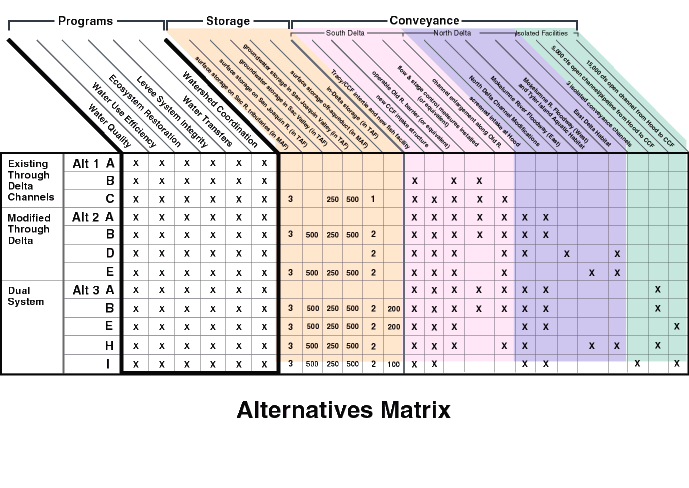
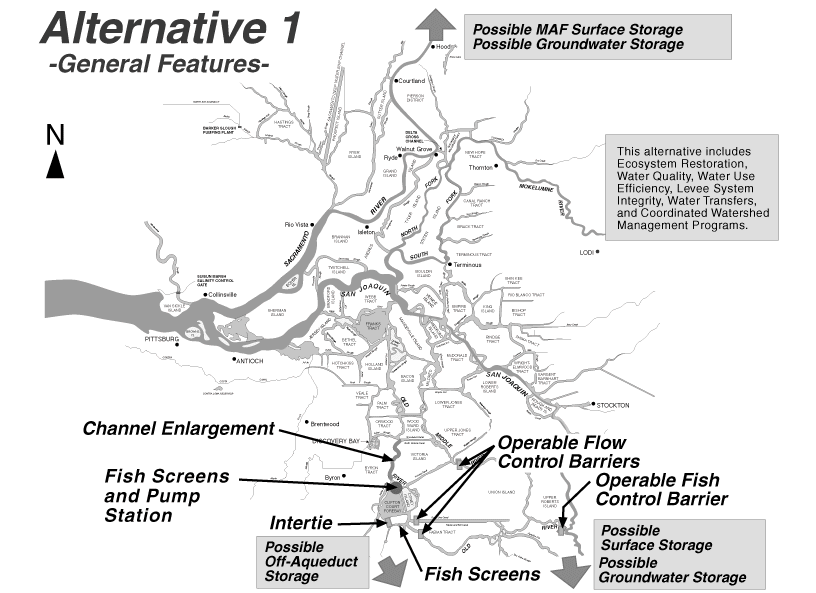
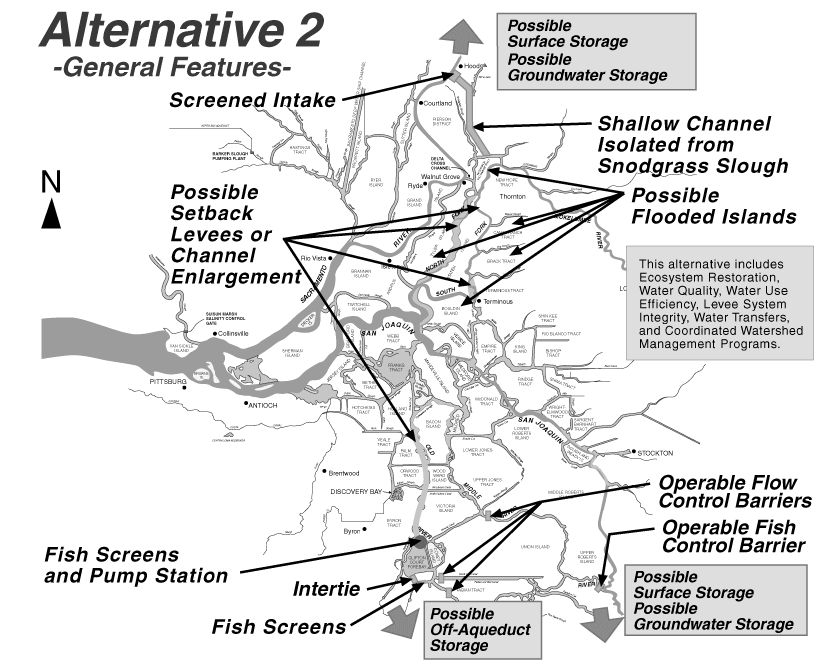
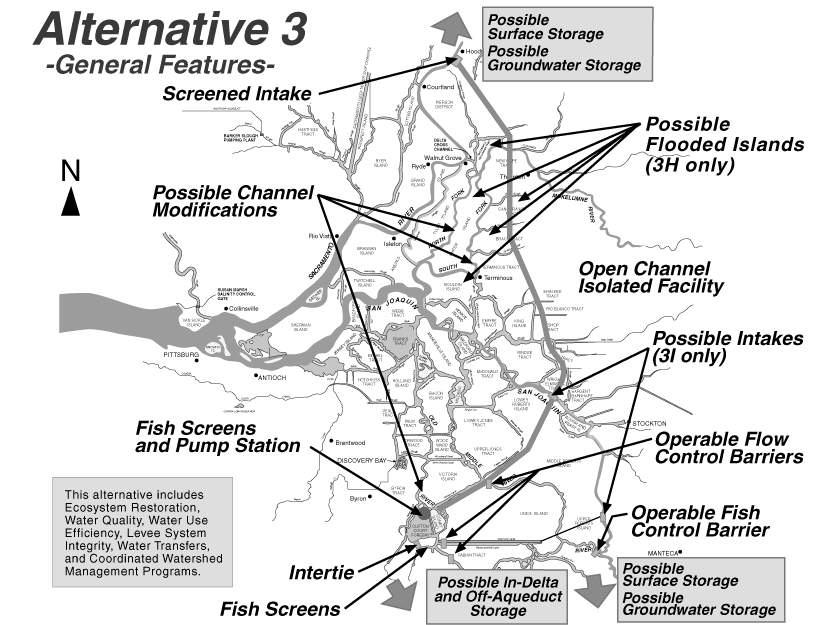
While there are countless combinations of potential modifications to Delta channels, three primary categories of Delta configuration options were studied in Phase II of the Program. The first conveyance configuration relies primarily on the existing conveyance system with some minor changes in the South Delta and a combination of ground and surface water storage options. The second configuration relies on enlarging channels within the Delta in combination with ground and surface water storage options. The third configuration includes in-Delta channel modifications and a conveyance channel that would move some water around the Delta in combination with ground and surface water storage options. |
SUMMARY OF ENVIRONMENTAL CONSEQUENCES
|
A similar range of water supply benefits occur with all Alternatives. Benefits in water supply and reliability increase with the amount of storage
Operation of the groundwater storage project could potentially reduce the significant adverse impacts to groundwater throughout all regions. All Alternatives would provide benefits to fisheries through the Ecosystem Restoration and Water Quality Programs. The Ecosystem Restoration Program, Water Quality Program and the Coordinated Watershed Management would lead to improved habitats with all alternatives. The CALFED Program presents both benefits and adverse impacts for agriculture. The Program could provide increased agricultural water supply and reliability, improved agricultural water quality and protection of agricultural lands in the Delta from serious flood risks. Conversely the Program could lead to significant conversion of agricultural land and its associated water supply. All Alternatives are expected to have some benefit to urban water supply and quality. |
The CALFED alternatives were analyzed to determine the potential for adverse and beneficial impacts. The Alternatives were compared to both existing conditions and the No Action Alternative. The No Action Alternative is the approximation of the physical, operational and regulatory features that would be in place in the year 2020. The most significant potential impacts of the CALFED Program are related to changes in surface waters, groundwater, geology and soils, fisheries and aquatic ecosystems, vegetation and wildlife, agricultural resources, urban resources, utilities and public services, recreational resources, flood control, and power production and energy. Surface Waters Operation of new storage facilities under Alternative 1C could provide some improvement in surface water quality by shifting export patterns. However, potential export increases under Alternative 1C could increase the frequency of reverse flows in the central and south Delta. Salinity and bromide concentrations would improve in the central and south Delta under Alternative 2 due to diversion of additional Sacramento River flows into the central Delta. These flow diversions would reduce the frequency of reverse flows in the central Delta under Alternative 2, however potential increases in south Delta exports could increase reverse flows in south Delta channels. Alternative 3 would result in reduced north Delta inflow, frequency of reverse flows in south Delta channels, and influence of south Delta pumping on Delta circulation. Alternative 3 would also provide the greatest water management flexibility and export water quality, but could have adverse impacts on south Delta water quality. Short-term adverse impacts on surface water quality could occur under all alternatives because of contaminant spills and erosion of sediments during construction of storage and conveyance facilities. With all alternatives it is anticipated that the Ecosystem Restoration Program would increase Delta outflow and improve water quality during low flows but could reduce water availability for agricultural and municipal purposes. The Levee System Integrity Program would reduce the risk of sudden and severe adverse changes in water quality that could accompany levee failure, and would increase water supply reliability. Water Transfers could have an adverse or beneficial impact on surface water quality depending on timing and flows. If construction methods are selected in order to minimize adverse environmental impacts and conventional construction mitigation measures are adopted, adverse changes in water quality could be mitigated. Impacts associated with construction of storage and conveyance facilities, including the habitat improvements of Alternatives 2 and 3 and Ecosystem Restoration Program elements, could be reduced by implementing conventional construction mitigation measures. Long-term adverse water quality effects in the southern Delta could be reduced by modifying the operation of storage and conveyance facilities. Groundwater Adverse third party effects could result in the Sacramento River and San Joaquin River regions. Increased groundwater use could cause land subsidence in the San Joaquin River Region, depending on local conditions and how individual projects are operated. Configurations 3B, 3E, and 3I include an in-Delta storage facility, which has the potential for increasing groundwater seepage problems in the Delta. Significantly increased groundwater pumping may be required. All Alternatives could result in adverse impacts as a result of reduction in groundwater recharge due to the Water Use Efficiency and Water Transfer Programs Mitigation strategies to prevent groundwater level declines could include creating additional groundwater or surface storage facilities so that demand can be met without resorting to groundwater overdrafting, importing water from other basins, purchasing water rights from willing sellers, regulating groundwater withdrawals so that they do not exceed the perennial yields of the basin, or implementing conservation measures to reduce demand. Geology and Soils Alternatives 2 and 3 are expected to reduce erosion and sedimentation in the Delta through channel widening. Applied salt loads would be reduced in the Delta and San Joaquin regions due to flows from additional storage facilities. Salt loads could increase if leaching becomes inadequate. Coordinated Watershed Management efforts may have adverse short-term impacts on surface soil and channel erosion, but are expected to have beneficial long-term impacts on stream geomorphology by reducing sediment from erosion. The Levee System Integrity Program would provide greater protection from inundation and salinity intrusion. The Water Use Efficiency Program would result in beneficial impacts in all regions, including reduced erosion from agricultural fields and decreased salinization of agricultural soils in all regions. Mitigation strategies could include protection of exposed soils and stabilization of disturbed sites to the extent possible during and after project construction activities to minimize soil loss. Fisheries and Aquatic Ecosystems Adverse impacts would result from diversions to new storage, increased exports operation of an intertie and construction of south Delta barriers. Construction of new reservoirs could also affect spawning and rearing habitat. Alternative 2 would have benefits associated with Delta flow conditions in the lower San Joaquin River which improve fish migration, and additional habitat restoration actions. Adverse impacts associated with Alternative 2 include increased entrainment, reduced productivity and habitat loss or degradation. Alternative 3 would include additional benefits from flow conditions in the east, central, and south Delta that reduce entrainment, increase productivity and improve fish migration. Operation of an isolated facility could result in increased entrainment and habitat degradation. A number of measures are available to avoid or mitigate impacts to fisheries and aquatic resources. Because of the uncertain results of actions affecting the ecosystem, CALFED actions will be implemented through an adaptive management approach. Adaptive management includes identification of indicators of ecosystem health, phased implementation, comprehensive monitoring of the indicators, and a commitment to remedial actions necessary to avoid, minimize, or mitigate immediate and future adverse impacts of project actions on ecosystem health. Mitigation measures would be part of an adaptive management program implemented to achieve the intent of the CALFED Bay-Delta Program and the major ecosystem-quality objectives. Vegetation and Wildlife The Levee System Integrity Program could benefit many species by protecting and enhancing certain habitats, but could have adverse effects on others resulting from levee construction, maintenance and dredge deposition. The Water Use Efficiency Program would cause beneficial impacts to riparian and wetland habitats in some stream reaches. Water Transfers specifically allocated for ecosystem purposes could provide beneficial impacts. However, changes in agricultural production as a result of increased efficiencies and water transfers may affect wildlife use of agricultural areas. Construction and operation of new storage and conveyance facilities would disrupt and displace some natural vegetation and wildlife communities. These impacts would include disturbance of habitats in the Delta and the Sacramento and San Joaquin river regions associated with construction of new storage facilities for some configurations under each alternative. Mitigation strategies are available for avoiding, restoring or enhancing habitats that may be affected by CALFED activities. For example, where construction activities would cause adverse impacts, phasing of program actions would help mitigate potential disturbance during mating or nesting seasons. Specific mitigation plans would be developed for each significant adverse impact caused by CALFED actions and would be implemented through a consultation process that would be consistent with California and federal Endangered Species Acts. Agricultural Resources Storage facilities could increase the amount of water available for agricultural production. All Alternatives would convert prime farmland and other agricultural lands and create potential conflicts between proposed actions and regional agricultural land use plans and policies. Agricultural job losses would represent adverse economic and social impacts. Significant reductions in crop revenue could result from the conversion of agricultural lands. The Ecosystem Restoration Program could improve reliability of water for agricultural purposes but could also involve the conversion of agricultural land and reduction of crop revenues and employment. The Water Quality Program would result in short-term reduced agricultural productivity and increased production costs. Long-term benefits include reduced production costs, higher crop yields, and greater crop selection flexibility. The Levee System Integrity Program would convert farmland, but provide greater protection of the remaining farmland from inundation and salinity intrusion. The Water Use Efficiency Program measures would result in increased crop yield for farmers, but could result in farm worker job loss. The Water Transfer Program would adversely affect agricultural production at the source of the transferred water and benefit production in the water-receiving regions. This would affect local economies and social well-being because of changes in employment and income. Coordinated Watershed Management would alter land use practices in the upper watershed, resulting in foregone economic opportunities. Urban Resources Alternative 2 (except 2A) is expected to provide additional water supply. Salinity reduction will reduce water supply costs. Water supply cost savings in Alternative 3 due to salinity reduction will be greater than in Alternative 2. The Ecosystem Restoration Program would have only negligible effects on urban land uses but could require relocation of major utility infrastructures. Coordinated Watershed Management would improve those parts of the affected upper watershed areas in the Sacramento River and San Joaquin River regions designated for habitat restoration. These types of activities would have only localized land use impacts and would likely not be incompatible with nearby land uses. The Levee System Integrity Program would have only negligible effects on urban land uses and municipal and industrial economics. The Water Use Efficiency Program is expected to increase the amount of urban water conservation. Recreational Resources Implementing any of three alternatives would result in a gain in open space and/or habitat uses, which would benefit recreational opportunities by restoring habitat, constructing levee improvements and conveyance facilities. Development of conveyance facilities could permanently close or relocate recreation facilities in the eastern portion of the Delta. These closures or relocations could result in adverse impacts to recreational opportunities and recreation employment. New or modified surface water storage facilities could have a wide range of adverse and beneficial impacts on recreational opportunities. Increasing storage capacity in existing reservoirs would increase water surface elevation The Ecosystem Restoration Program would convert existing open space uses in the Delta, Sacramento River, and San Joaquin River regions. Implementation of each Alternative would benefit several key fishery species would benefit in the Bay, Delta, San Joaquin River and Sacramento River regions. This would improve commercial and sport fishing opportunities, thus increasing the number of related jobs. The Water Quality Program would increase the recreation value of the Delta. The Levee System Integrity Program would displace some existing recreation facilities, resulting in a loss of recreation opportunities and a potential loss of recreation-related jobs. Flood Control Flood control benefits from levee improvements and Delta channel modifications in the Delta Region would occur, but with large annual costs for construction and maintenance. Alternative 2 is expected to have more benefits than Alternative 1 because of Delta conveyance improvements. The isolated conveyance facility and channel improvements as part of Alternative 3 are expected to provide additional benefits. Potential flood control benefits are expected downstream of off-stream storage sites depending on facility operations. The Ecosystem Restoration and Water Quality Programs are expected to have beneficial impacts on flood control. Power Production and Energy Construction of new storage facilities are expected to increase average and dry year energy generation and capacity as new hydropower facilities are added. The Alternatives would increase project energy use as operations change, decrease the amount of CVP energy available for sale, and increase the SWP's net energy requirement. The composite energy rate for Western Area Power Authority and DWR's system energy rate could increase slightly. Western and DWR power values would increase, because the increase in project energy use would be greater than the increase in generation. Other Environmental Consequences Other environmental consequences would include short-term air quality, noise, and transportation impacts associated with construction of new facilities, typical of larger construction projects. Standard construction practices would be used to minimize these effects. Cultural resources could also be affected by construction activities. Mitigation for these effects would be consistent with the requirements of the National Historic Preservation Act and other related legislation. Impacts to public and environmental hazards and Indian Trust Assets are expected to be minimal. Visual impacts would occur at reservoir sites, that would have to be considered in the layout and design of new facilities to minimize visual intrusion. With regard to environmental justice, some actions could have a disproportionate impact on minority and low income populations, including migrant workers as agricultural land is converted to other uses. MOVING TOWARDS THE PREFERRED PROGRAM ALTERNATIVEThe twelve alternative configurations cover a broad range of potential consequences of implementing a CALFED solution. As CALFED moves towards a preferred program alternative, the evaluations will become more and more focused. Although more specific evaluations may be needed to define the preferred program alternative, the consequences of the preferred program alternative will be bound by the range of consequences described for the twelve alternative configurations.
As a tool in moving towards a preferred program alternative, CALFED agencies used the distinguishing characteristics information and sought to develop the best alternative for each of the three main categories:
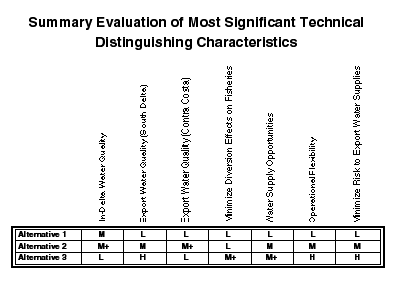
Among the distinguishing characteristics, some were found through the evaluation process not to vary greatly among the alternatives, while other characteristics truly allowed CALFED to distinguish differences in performance. These more critical characteristics are the ones in the left column on the following table. CALFED has not made any determination about how the alternatives perform in terms of "assurances" or "consistency" with solution principles. Although extremely critical to the ultimate decision of a preferred program alternative, evaluation of these two characteristics is highly subjective, and CALFED intends to make that evaluation only after considering the comments of the interested public.
Comparison of Alternatives The table on the following page provides a general comparison of the alternatives according to the eight most distinguishing characteristics. The Phase II Interim Report Appendix discusses the major differences between the alternatives on the key technical distinguishing characteristics. Based on the assumptions made in these technical evaluations, Alternative 3 appears to have the potential to provide greater performance on these particular characteristics. At the same time Alternative 3 appears to present the most serious challenges in terms of assurances and implementability. The figure on the following page provides a general comparison of the alternatives according to the eight distinguishing characteristics. Qualitative rankings of high (H), medium (M), and low (L) were used to summarize the three alternatives. The evaluation depicted graphically here treats each of the key distinguishing characteristics as if they were of equal importance. It is important to understand, however, that it is unlikely that all of the key distinguishing characteristics are of equal importance, and different weighting of these factors could affect the outcome of the analysis. In addition, the table does not attempt to "standardize" the scales for each characteristic. , The relative difference between an "L" and an "M" on one characteristic may be totally different than the difference between an "L" and an "M" on another characteristic. Interested parties, the public, and CALFED agencies must collectively determine the importance of each distinguishing characteristic in the overall evaluation of alternatives leading to selection of the preferred alternative.
Two key distinguishing characteristics seem to be particularly important in making a decision on how well the alternatives perform. Export Water Quality and Diversion Effects on Fisheries, are highly dependent on the alternative selected. Therefore, irrespective of whether these two characteristics are the most important to selection of the preferred alternative, they are the characteristics most dependent on that decision. Next Steps CALFED has not identified a preferred program alternative. A great deal of dialogue will need to take place among elected officials, CALFED agencies, local agencies, interest groups, and the public before a decision can be made. Together, all interests will need to answer questions such as:
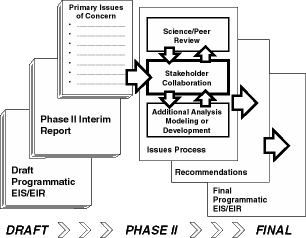
During the process of developing the Program elements and evaluating the alternatives, many issues and concerns were identified. Some of these issues must be addressed in order to facilitate selection of a preferred alternative. These issues, as shown in the adjacent sidebar, vary in their potential significance in selecting an alternative and in the implementation approach to be taken. As shown in the figure above, some issues may require independent science review, focused stakeholder collaboration or simply additional analysis and development. Between the Public Draft Programmatic EIS/EIR and the Final Programmatic EIS/EIR work will continue on resolving the issues of concern as well as defining and selecting the preferred program alternative. The CALFED agencies will work with elected officials, local agencies, interests groups and the public over the coming months to develop a preferred program alternative which reduces major conflicts in the system, is equitable, affordable, durable, implementable and will not solve problems in the system by re-directing impacts. |